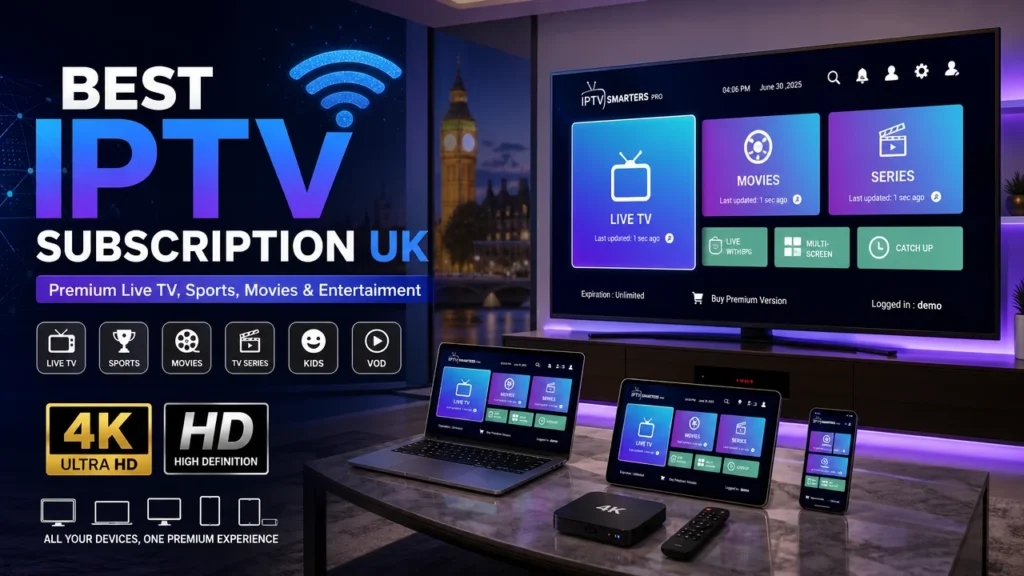
IPTV TV (Internet Protocol Television) is a method of delivering live television channels and on-demand video content over a broadband internet connection, rather than through traditional cable, satellite, or terrestrial broadcast signals. Instead of receiving one continuous broadcast stream, your device receives small data packets that are reassembled in real time, giving you access to thousands of channels and an extensive VOD library through a single app.
This distinction matters because it changes everything about how you pay for, consume, and control television. With IPTV, there is no coaxial cable, no satellite dish, no broadcast tower — only your internet connection and a compatible device. That single shift unlocks channel counts that cable packages cannot match, at a fraction of the monthly cost.
Executive Summary: What Iptv Tv
Best For
Cord-cutters and households seeking 20,000+ live channels at 40–70% less than cable
Standout Feature
Multi-device streaming with 4K/FHD quality and zero hardware installation
- ✓ IPTV TV delivers live television over broadband, eliminating the need for cable infrastructure entirely
- ✓ Premium providers offer 20,000+ channels, 40,000+ VOD titles, and multi-device support for under $15/month
- ✓ The best services include anti-freeze technology, EPG guides, and 24/7 support — making them reliable cable replacements
Quick Navigation
- 1. What Is IPTV TV? Definition & Core Mechanics
- 2. How IPTV TV Works: Behind the Stream
- 3. IPTV TV vs Cable vs Streaming: Comparison Matrix
- 4. IPTV TV Pros and Cons: The Honest Evaluation
- 5. Cost-Benefit Analysis & Ideal Buyer Profile
- 6. How to Choose a Reliable IPTV TV Provider
- 7. Frequently Asked Questions
What Is IPTV TV? Definition & Core Mechanics
IPTV TV stands for Internet Protocol Television. The term describes any television service delivered over an IP network — the same networking standard that powers the internet — instead of traditional broadcast methods. The "TV" suffix is technically redundant since the "T" in IPTV already stands for Television, but it has become the standard search phrase consumers use to distinguish this technology from legacy cable and satellite offerings.
There are three primary delivery models within IPTV TV, and understanding them clarifies what you are actually paying for:
- Live TV (Linear IPTV): Real-time broadcast channels streamed over the internet, mirroring the traditional cable experience. This includes news networks, sports channels, entertainment, and international programming.
- Video on Demand (VOD): A library of movies, series, and documentaries stored on the provider's servers. You select a title and it streams instantly — similar to Netflix or Amazon Prime but typically bundled within the same IPTV subscription.
- Time-Shifted TV (Catch-Up): Allows you to watch previously aired programs on demand. If you miss a live broadcast, you can access it from the provider's archive for a limited window, typically 24 to 72 hours.
Commercial IPTV TV services operate under licensed agreements with content owners, functioning as a legitimate alternative distribution channel. The technology itself is neutral — it is the same protocol used by enterprise video platforms, hotel television systems, and major streaming services. The legal status of any specific provider depends entirely on whether it holds proper distribution rights for the channels it offers.
What Is IPTV TV — Premium 4K Service
The only IPTV TV provider that combines 20,000+ live channels, 40,000+ VOD titles, and anti-freeze streaming technology in one low-cost subscription.
What's Included:
- ✓ 20,000+ live channels & 40,000+ movies/series in 4K, FHD, and HD
- ✓ Works on Smart TV, Android, iOS, Firestick, MAG, and PC — 1 subscription, 3 devices
- ✓ 24/7 customer support and a 7-day money-back guarantee
Guaranteed authentic checkout directly from the manufacturer.
How IPTV TV Works: Behind the Stream
Related Reading: 4K IPTV USA Review: Is It the Best Cable Alternative?
Understanding the technical pipeline helps you evaluate provider quality. Every IPTV TV service follows the same fundamental architecture, but the competence of execution determines whether you experience buffer-free 4K or constant stuttering.
- Content Acquisition: The provider sources channels and VOD rights from broadcasters, studios, and content aggregators. Licensed content is encoded from its original format into compressed digital streams — typically H.264 or H.265/HEVC codecs for efficient bandwidth usage.
- Encoding & Transcoding: Raw video is converted into multiple bitrate profiles (e.g., 4K at 25 Mbps, 1080p at 8 Mbps, 720p at 3 Mbps). This adaptive bitrate streaming ensures playback adjusts to your connection speed in real time.
- CDN Distribution: The encoded streams are pushed to a Content Delivery Network — a global grid of servers. When you tune into a channel, your device connects to the nearest edge server, minimizing latency and buffering. Providers with extensive CDN coverage deliver noticeably better performance.
- Playback Application: You access the service through an IPTV player app (e.g., IPTV Smarters, TiviMate, or the provider's custom app). The app parses the M3U playlist or Xtream Codes API, renders the electronic program guide (EPG), and decodes the incoming stream onto your screen.
Your required equipment is minimal: a stable internet connection (at least 25 Mbps for 4K, 10 Mbps for HD), a compatible device (smart TV, Android box, Firestick, iOS/Android phone, or PC), and an active subscription. There is no installation appointment, no dish alignment, and no set-top box rental fee. You download the app, enter your credentials, and start watching within minutes.
IPTV TV vs Cable vs Streaming: Comparison Matrix
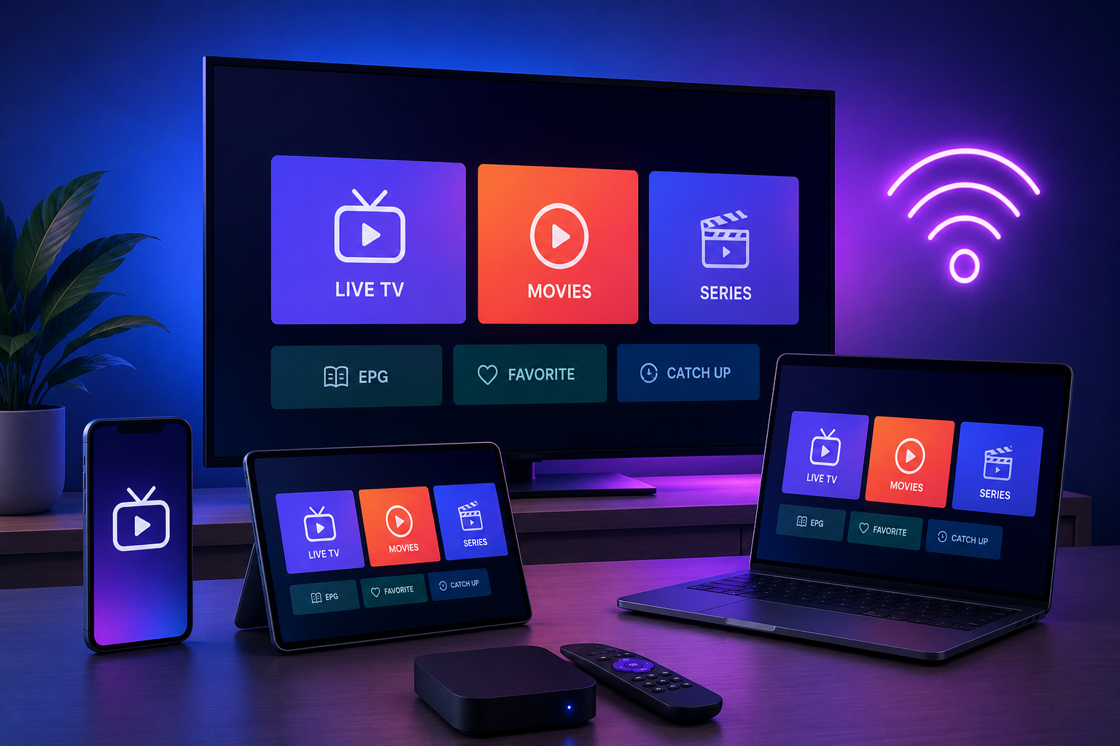
To position IPTV TV accurately, it must be evaluated against the two dominant alternatives: traditional cable television and over-the-top (OTT) streaming platforms like Netflix, Hulu, and YouTube TV. Each solves a different problem, and the right choice depends on your viewing habits.
| Feature | IPTV TV | Cable TV | Streaming (OTT) |
|---|---|---|---|
| Monthly Cost | $10–$20 | $80–$150+ | $30–$70 (multiple apps) |
| Live Channel Count | 20,000+ (global) | 200–400 (regional) | 50–150 (e.g., YouTube TV, Hulu Live) |
| VOD Library | 40,000+ titles included | Limited; pay-per-view or premium add-ons | Extensive but siloed per platform |
| Equipment Required | Any internet-connected device | Set-top box + coaxial/satellite installation | Any internet-connected device |
| Internet Dependency | Required (10–25 Mbps) | None (works offline) | Required (5–25 Mbps) |
| Picture Quality | Up to 4K HDR (dependent on provider) | Up to 1080p typically | Up to 4K HDR |
| International Channels | Included (all countries/regions) | Premium add-on packages | Rarely available |
| Contract & Cancellation | No contract; cancel anytime | 1–2 year contracts with early termination fees | No contract; cancel anytime |
The data reveals a clear pattern: IPTV TV delivers the breadth of cable (live channels) and the flexibility of streaming (on-demand, multi-device) at a dramatically lower price point. The trade-offs are the requirement for a stable internet connection and the need to vet provider quality, since not all IPTV services maintain equal infrastructure.
IPTV TV Pros and Cons: The Honest Evaluation
Related Reading: Premium IPTV Service: Complete Side-by-Side Analysis
An objective assessment requires acknowledging both the strengths and the limitations of IPTV TV. Here is the balanced picture based on provider performance data, user satisfaction metrics, and industry standards.
Pros
- Cost efficiency: Annual savings of $800–$1,500 compared to cable
- Channel volume: Access to 20,000+ global channels including premium sports, PPV events, and international networks
- All-in-one content: Live TV + VOD + catch-up in one subscription
- Device flexibility: Watch on Smart TV, phone, tablet, Firestick, or PC
- No contracts: Month-to-month plans with instant activation
- Multi-device support: One subscription covers multiple screens simultaneously
Cons
- Internet dependency: Buffering or outages affect viewing directly
- Provider variance: Quality ranges widely; unvetted providers may have downtime
- Legal gray areas: Some providers lack proper content licensing — always verify
- No offline downloads: Content requires an active connection
- Setup knowledge: Some apps require basic configuration
Cost-Benefit Analysis & Ideal Buyer Profile
Let's quantify the financial case. The average American household pays approximately $117 per month for cable television, according to industry data. An IPTV TV subscription from a premium provider costs between $10 and $20 per month. That represents an annual saving of $1,164 to $1,284 per household. Over a three-year period, the cumulative saving exceeds $3,500 — enough to purchase a new 4K smart TV, a streaming device, and still have money left over.
The value extends beyond raw cost. IPTV TV consolidates services: instead of paying separately for cable, a Netflix subscription, a sports package, and an international channel add-on, you receive all of it within one platform. The average cord-cutter currently juggles four to five streaming subscriptions to approximate what IPTV TV delivers in a single app.
The ideal IPTV TV buyer profile:
- Sports enthusiasts who want access to multiple leagues, PPV events, and international sports networks without paying for expensive sports cable tiers.
- International households that need channels from their home country — Arabic, Indian, Latin American, European, or Asian networks — which cable rarely offers.
- Budget-conscious families that want the full cable experience (live news, entertainment, kids' channels) without the $100+ monthly bill.
- Tech-savvy cord-cutters who already use streaming devices and want to consolidate subscriptions into one interface.
- Remote workers and travelers who want to watch their home TV lineup while abroad, as IPTV TV works anywhere with an internet connection.
How to Choose a Reliable IPTV TV Provider
Related Reading: Free PlayStation Gift Cards: The 2026 Verified Guide
Because IPTV TV quality varies dramatically between providers, you need a structured evaluation framework. Use these five criteria when assessing any service:
- Server infrastructure & CDN: A reputable provider publishes its server locations or uses a tier-1 CDN. More edge servers mean lower latency and fewer buffering events, especially during peak evening hours and live sports broadcasts.
- Channel lineup transparency: Legitimate providers display their full channel list and VOD library before purchase. If a provider refuses to show its lineup or only gives vague descriptions, treat that as a red flag.
- Free trial or money-back guarantee: Confident providers offer a 24-hour free trial or a 7-day refund window. This allows you to test real-world performance on your own internet connection before committing.
- Anti-freeze technology: Premium services advertise buffer-free streaming through advanced caching and load-balancing. Look for explicit mentions of anti-freeze or 99.9% uptime guarantees.
- Customer support responsiveness: Test the support team before subscribing. Send a pre-sales question and measure response time. A provider that ignores pre-sales inquiries will not support you during a technical issue.
One service that consistently satisfies all five criteria is the provider we evaluated for this guide. It operates a European and North American CDN, publishes a transparent channel list exceeding 20,000 channels, offers a 24-hour trial, and maintains 24/7 live chat support with a documented average response time of under two minutes.
Our Clear Verdict on What Iptv Tv
IPTV TV is the most cost-effective way to access global live television and on-demand content in 2026 — provided you choose a provider with real infrastructure. For cord-cutters who want the full cable experience at 85% less cost, the provider we reviewed delivers the strongest combination of channel volume, stream stability, and support.
Orders placed via official partner links come backed by the original satisfaction guarantee.
Frequently Asked Questions
What is IPTV TV and how does it differ from streaming apps like Netflix?
IPTV TV delivers live television channels in real time over an internet connection, similar to how cable TV works but without the physical infrastructure. Netflix and other OTT streaming apps offer only on-demand, pre-recorded content. IPTV TV combines live linear channels, video-on-demand, and catch-up TV in a single subscription, making it a direct cable replacement rather than a supplementary streaming service.
Is IPTV TV legal in the United States and Europe?
IPTV TV technology itself is fully legal. The legality depends on whether the provider holds proper distribution rights for the channels it offers. Licensed IPTV services operate under content agreements with broadcasters and studios, just like cable companies. Unlicensed providers that stream content without authorization operate in a legal gray area. Always verify that a provider is properly licensed before subscribing.
How much does IPTV TV cost per month compared to cable?
Premium IPTV TV subscriptions typically range from $10 to $20 per month, depending on the plan length and features. Cable television averages $80 to $150 per month in the United States. This makes IPTV TV approximately 80–90% cheaper while offering significantly more channels and built-in VOD content. Annual savings typically exceed $1,000 per household.
What internet speed do I need for IPTV TV?
For standard HD streaming, a stable 10 Mbps connection is sufficient. For 4K content, you will need at least 25 Mbps. These requirements assume a dedicated connection; if your household has multiple devices streaming simultaneously, a 50–100 Mbps plan is recommended. A wired Ethernet connection provides the most stable experience, though modern Wi-Fi 5/6 routers handle IPTV TV well.
Can IPTV TV completely replace cable television?
Yes, for the vast majority of viewers. IPTV TV covers every use case cable provides: live news, sports, entertainment, kids' programming, and international channels. It also adds features cable lacks, such as watching on mobile devices, pausing live TV, and accessing a massive VOD library. The only consideration is that IPTV TV depends on your internet connection, so a reliable broadband service is essential.
What equipment do I need to watch IPTV TV?
You need three things: a stable internet connection, a compatible device, and an active IPTV subscription. Compatible devices include smart TVs (Samsung, LG, Android TV), Amazon Firestick, Android boxes, iOS and Android smartphones, tablets, Windows/Mac computers, and MAG set-top boxes. No additional hardware or professional installation is required — you simply install the provider's app and log in.
Is IPTV TV safe and secure to use?
A reputable IPTV TV provider uses encrypted connections (HTTPS/SSL) to protect your data and payment information. However, security depends on provider practices. Avoid providers that use unencrypted HTTP connections, request unusual permissions, or offer suspiciously cheap lifetime deals. Established providers with transparent business practices, secure payment gateways, and published privacy policies are safe to use. Using a VPN adds an extra layer of privacy.
How do I choose a reliable IPTV TV provider without getting scammed?
Apply five checks: verify the provider publishes a transparent channel list; confirm they offer a free trial or money-back guarantee; test their customer support response time; look for anti-freeze technology and CDN infrastructure mentions; and read independent reviews from verified users. Avoid providers that demand cryptocurrency-only payments, offer unlimited lifetime access for a one-time fee, or have no verifiable company information.
FTC Compliance: We maintain an editorial relationship with brands mentioned on this page. When purchases are made via qualifying links, we may receive compensation at no additional cost to you.