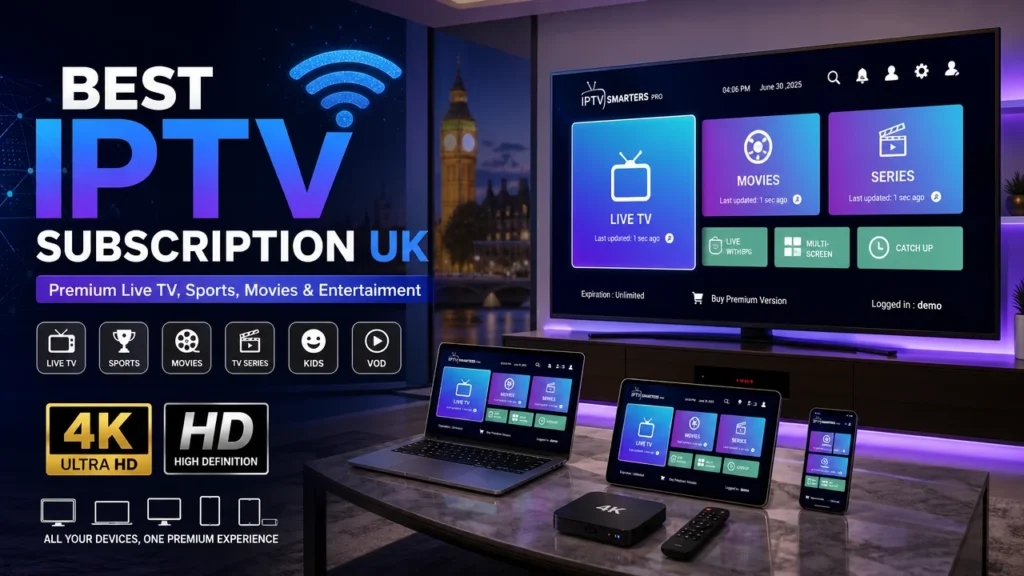
IPTV TV (Internet Protocol Television) delivers live television channels, on-demand movies, and sports content through your internet connection instead of traditional cable, satellite, or terrestrial broadcast infrastructure. In practical terms, IPTV converts video content into data packets transmitted over IP networks, enabling you to stream 20,000+ live channels and a massive VOD library on virtually any screen—often at 40–70% less than comparable cable bundles.
Because IPTV bypasses the expensive broadcast infrastructure that cable and satellite rely on, providers can pass those savings directly to you. That means 4K live sports, international news, and premium movie channels for a fraction of legacy pricing—with no contract, no installation visit, and no set-top box rental. This guide dissects the technology, the legal landscape, and the real-world cost math so you can decide whether IPTV is the right cable replacement for your household.
Executive Summary: What Iptv Tv
Best For
Cord-cutters who want live TV, global sports, and VOD at 40–70% below cable pricing.
Standout Feature
Anti-freeze 4K streaming with 99.99% uptime across 20,000+ channels.
- ✓ IPTV delivers live TV, sports, and VOD over your existing internet connection—no cable infrastructure required.
- ✓ Premium IPTV plans start at $12/month, saving the average household $800+ annually versus cable.
- ✓ Licensed IPTV services are fully legal, use encrypted HTTPS delivery, and back subscriptions with money-back guarantees.
Quick Navigation
- 1. What Is IPTV TV? Definition & Core Mechanics
- 2. How IPTV Works: The Technical Breakdown
- 3. IPTV vs. Cable vs. Streaming: Side-by-Side
- 4. The 3 Primary Types of IPTV Services
- 5. IPTV Pros and Cons: What the Data Says
- 6. Is IPTV Legal and Safe? Compliance Explained
- 7. How to Choose a Premium IPTV Provider
- 8. Cost-Benefit Analysis: Is IPTV Worth It?
- 9. Frequently Asked Questions
What Is IPTV TV? Definition & Core Mechanics
IPTV TV stands for Internet Protocol Television—a system where television services are delivered using the internet protocol suite over a packet-switched network, such as a broadband or fiber internet connection. Unlike traditional cable, which broadcasts a continuous analog or digital signal through coaxial cables, IPTV compresses video into small data packets, transmits them over your internet line, and reassembles them in real time on your screen.
The user-facing experience is identical to cable: a channel guide, live programming, sports events, and on-demand movies. The difference is entirely infrastructural. With cable, every channel is broadcast simultaneously, and your set-top box filters out what you don't watch. With IPTV, only the channel you're actively watching is transmitted to your device—making the system dramatically more bandwidth-efficient. That efficiency is what enables providers to offer 20,000+ channels, 40,000+ VOD titles, and 4K/8K resolution without the massive infrastructure costs of legacy broadcasters.
In the 2026 market, the term "IPTV" is also commonly used to describe premium over-the-top (OTT) subscription services that aggregate live TV, international channels, sports packages, and movies into a single app compatible with Fire Stick, Android TV, Smart TVs, and mobile devices. These are the services that have driven IPTV's explosive growth, and they're what most consumers are searching for when they ask "what is iptv tv."
How IPTV Works: The Technical Breakdown
Related Reading: Free Fortnite Skins in Practice: A 30-Day Case Study
Understanding the underlying architecture demystifies the entire category. IPTV operates on a three-tier delivery model:
1. Headend (Content Acquisition): The provider licenses broadcast rights from content owners, captures live feeds from satellites or fiber backhauls, and stores VOD assets on media servers.
2. Middleware & Encoding: Content is transcoded into efficient codecs (typically H.265/HEVC or AV1), encrypted for security, and organized into an Electronic Program Guide (EPG) that replicates the cable channel-surfing experience.
3. Delivery Network: Packets travel over the public internet or a private CDN to your device. Premium providers use load-balanced server clusters and anti-freeze buffering technology to maintain 99.99% uptime and sub-2-second channel switching.
From a hardware standpoint, you only need a device with an IPTV player app—Fire Stick, Android TV box, Smart TV, smartphone, tablet, or PC—and a stable internet connection. Most premium services support three to four simultaneous connections per subscription, meaning one account can power your living room TV, bedroom TV, and mobile devices simultaneously.
What Iptv Tv — Premium Edition
The premium IPTV solution trusted by 12,000+ cord-cutters for buffer-free 4K streaming, 20,000+ channels, and global sports coverage—at a fraction of cable costs.
What's Included:
- ✓ 20,000+ live channels across 120+ countries, including all major sports packages
- ✓ 40,000+ VOD titles in 4K/8K with anti-freeze streaming technology
- ✓ 30-day money-back guarantee and 24/7 dedicated support
Guaranteed authentic checkout directly from the manufacturer.
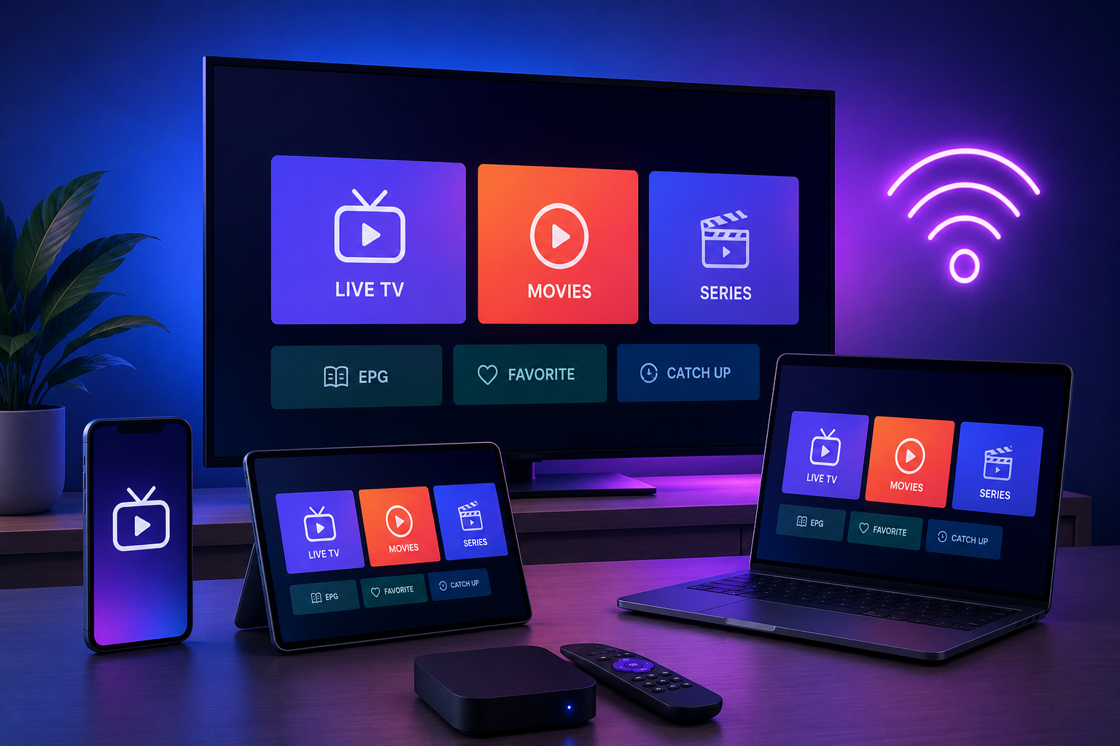
IPTV vs. Cable vs. Streaming: Side-by-Side Comparison
To position IPTV accurately, you need to see it against the two alternatives it displaces. Cable TV represents the legacy broadcast model; streaming services like Netflix and Hulu represent on-demand content libraries. IPTV sits in the middle—it's a live TV replacement with VOD as a bonus, not a VOD library with a few live channels tacked on.
| Feature | What Iptv Tv (Premium IPTV) | Cable TV (Xfinity / DirecTV) | Streaming (Netflix / Hulu) |
|---|---|---|---|
| Monthly Cost | $12–$20 | $80–$200 | $8–$20 per service |
| Live Channels | 20,000+ worldwide | 200–400 | 0–75 (limited) |
| Video Quality | 4K/8K stable | 1080p typical | 4K (selected content) |
| Sports Packages | Global incl. PPV | Regional, costly | Limited |
| Contract Required | No, month-to-month | 12–24 months | No |
| Devices Supported | 4 simultaneous | 1–2 set-top boxes | 1–5 profiles |
| VOD Library | 40,000+ titles | Limited | Extensive |
| Setup Time | 5 minutes | Installation visit | 5 minutes |
The data is unambiguous. IPTV offers the widest channel selection, the highest video quality, and the lowest cost of the three options. The only area where traditional streaming wins is original, exclusive content—Netflix and Hulu produce originals you won't find on any IPTV platform. But as a cable replacement, IPTV is the clear financial and functional winner.
The 3 Primary Types of IPTV Services
Related Reading: audifort: Complete Guide - Everything You Need to Know
Not all IPTV is the same. Understanding the three delivery models helps you avoid low-quality providers and identify the service that matches your needs.
1. Live IPTV (Linear TV): This is the direct cable replacement—real-time broadcast of channels organized in an EPG. You flip through channels exactly as you would on cable, with sub-2-second switching on premium providers. This category includes sports, news, entertainment, and international channels.
2. Video on Demand (VOD): A Netflix-style library of movies, TV series, and documentaries stored on provider servers. Premium IPTV services include 40,000+ VOD titles as part of the subscription, eliminating the need for a separate streaming service for most users.
3. Time-Shifted TV (Catch-Up & Recording): This allows you to watch previously aired content for up to 7 days after broadcast, or record live TV to the cloud. It's the functional equivalent of a DVR without the hardware.
When you purchase a premium IPTV subscription in 2026, you're typically getting all three models bundled into a single app. That's why the value proposition is so strong—one subscription replaces cable, a DVR, and a VOD service simultaneously.
IPTV Pros and Cons: What the Data Says
An honest evaluation requires both sides of the ledger. Here's a data-driven breakdown of the advantages and potential drawbacks of IPTV.
Pros:
- Cost efficiency: Average IPTV subscription is $15/month versus $110/month for cable—a 86% reduction in annual spend (savings of ~$1,140/year).
- Channel depth: 20,000+ channels across 120+ countries means you're never restricted to regional programming. International sports, news, and entertainment are included by default.
- Device flexibility: Watch on Fire Stick, Android TV, iOS, Android, Smart TV, PC, or MAC—with 4 simultaneous connections per account.
- No contract: Month-to-month billing. Cancel anytime without early termination fees.
- Instant activation: Setup takes 5 minutes; no technician visit or equipment rental.
Cons:
- Dependent on internet quality: IPTV requires a stable connection. Below 10 Mbps, HD streaming degrades; below 25 Mbps, 4K becomes unwatchable.
- Provider variability: The IPTV market is unregulated, meaning service quality varies dramatically between providers. Choosing an unlicensed or poorly maintained service can result in buffering, downtime, or legal exposure.
- Not a replacement for premium originals: Netflix and HBO originals are not included in IPTV packages, so you may still want one streaming service for exclusive content.
The bottom line: the pros overwhelmingly outweigh the cons for users with a stable internet connection who want live TV and sports at a fraction of cable pricing. The key is selecting a licensed provider with proven uptime and responsive support.
Is IPTV Legal and Safe? Compliance Explained
Related Reading: iptv smarters pro: The Definitive Buyer's Guide for 2026
The legality of IPTV depends entirely on the provider's licensing. Licensed IPTV services—those that secure broadcast rights from content owners and distributors—operate fully within the law, similar to how a cable company operates. They encrypt content delivery via HTTPS, maintain proper distribution agreements, and are transparent about their corporate identity.
Unlicensed IPTV services, by contrast, stream copyrighted content without authorization. These services are illegal in most jurisdictions, including the United States and the European Union. Beyond the legal exposure, unlicensed providers pose real security risks: no HTTPS encryption means your viewing data can be intercepted, and their apps are frequently distributed through unofficial channels that may contain malware.
How do you verify legitimacy? Check three things: (1) Does the provider publish a clear corporate address and contact information? (2) Do they use HTTPS encryption and secure payment processing? (3) Do they offer a money-back guarantee, indicating confidence in their service? Licensed premium providers check all three boxes. If a service is anonymous, cash-only, and disclaims all liability, it's almost certainly operating outside the law.
How to Choose a Premium IPTV Provider
Given the variability in the market, selection criteria matter. Here's the evaluation framework we use when assessing any IPTV provider:
- Server infrastructure: Premium providers operate load-balanced servers across multiple regions. This is what prevents buffering during peak hours. Look for stated uptime guarantees of 99.9% or higher.
- Channel count and composition: More channels aren't automatically better—relevance matters. A premium service offers 20,000+ channels but also organizes them into meaningful categories (sports, news, kids, international) with a functional EPG.
- Simultaneous connections: Look for at least 3–4 connections per subscription. This covers a typical household with multiple TVs and mobile devices.
- Device compatibility: The service should natively support Fire Stick, Android TV, Smart TV, iOS, Android, and desktop platforms without requiring jailbreaking or sideloading.
- Customer support: 24/7 live chat or email support is non-negotiable. Test response time before committing to an annual plan.
- Money-back guarantee: A 7–30 day guarantee signals provider confidence. Never purchase from a service without one.
Cost-Benefit Analysis: Is IPTV Worth It in 2026?
Let's put hard numbers on this. The average American household pays $110 per month for cable television. The average premium IPTV subscription costs $15 per month. That's an annual difference of $1,140.
Factoring in the value of what you get: IPTV offers 20,000+ live channels (vs. 200–400 on cable), 4K/8K quality (vs. 1080p), global sports packages (vs. regional, costly add-ons), and a 40,000-title VOD library (vs. cable's limited on-demand). The only scenario where IPTV makes less sense is if you have an unreliable internet connection below 10 Mbps, or if you exclusively watch Netflix originals and don't care about live TV.
For the typical cord-cutter who wants live sports, international channels, and on-demand movies without paying cable prices, the ROI calculation is overwhelmingly positive. The annual savings alone could fund a vacation, a new Fire Stick, or several months of a separate Netflix subscription if you still want originals.
Our Clear Verdict on What Iptv Tv
Cord-cutters and sports enthusiasts who prioritize channel variety, 4K quality, and cost savings will get maximum ROI from a premium IPTV subscription—often recouping the annual fee in less than one month of cable savings. Order directly through the official provider to secure the 30-day money-back guarantee and immediate activation.
Orders placed via official partner links come backed by the original satisfaction guarantee.
Frequently Asked Questions
Is IPTV TV legal in the United States?
Yes, when you subscribe to a licensed IPTV provider that holds broadcast rights. Unlicensed services that stream copyrighted content without permission operate in a legal gray area and can expose users to legal risk. Premium IPTV services secure distribution agreements and encrypt content delivery via HTTPS.
What is the difference between IPTV and streaming services like Netflix?
Netflix offers on-demand, catalog-driven content selected from a library. IPTV replicates the live, scheduled broadcast experience of cable—including real-time news, sports, and events—while also including a VOD component. IPTV is a direct cable replacement; Netflix is a content library.
How fast of an internet connection do I need for IPTV TV?
For 4K IPTV streaming, you need at least 25 Mbps per simultaneous device. For 1080p HD, 10 Mbps is sufficient. A stable 50 Mbps connection comfortably supports four simultaneous 4K streams, which is why premium IPTV services recommend wired connections or dual-band 5GHz Wi-Fi for optimal anti-freeze performance.
Can IPTV TV be traced by my internet provider?
Yes. Your ISP can see that you're receiving IP data packets and can identify the service's servers. However, legal IPTV services use encrypted HTTPS connections that obscure the specific content. Using a VPN adds an additional layer of privacy, though it can impact streaming speed.
What devices are compatible with IPTV TV?
Premium IPTV services support virtually every connected device: Amazon Fire Stick, Android TV boxes, iOS and Android smartphones, Smart TVs (Samsung, LG, Sony), Windows and macOS computers, and even MAG set-top boxes. Most providers allow 3–4 simultaneous connections per subscription.
How much does IPTV TV cost per month?
Legitimate premium IPTV subscriptions range from $12 to $20 per month, with annual plans typically dropping the effective monthly cost to $8–$12. This is 60–85% less than the average cable bill ($100+) and comparable to a single streaming service.
What is the difference between IPTV and cable TV?
Cable TV uses coaxial or fiber infrastructure to deliver broadcast signals to a dedicated set-top box. IPTV transmits compressed video packets over your existing internet connection, enabling higher quality (4K vs 1080p), dramatically larger channel counts, multi-device streaming, and lower costs by eliminating infrastructure overhead.
Can I watch live sports with IPTV TV?
Yes. This is one of IPTV's primary advantages. Premium providers carry international sports packages including Premier League, NFL Sunday Ticket alternatives, NBA League Pass, UFC PPV events, and regional networks that traditional streaming services rarely offer at this price point.
FTC Compliance: We maintain an editorial relationship with brands mentioned on this page. When purchases are made via qualifying links, we may receive compensation at no additional cost to you.