A premium IPTV service delivers live television and on-demand video over your internet connection with guaranteed stream stability, extensive channel lineups, and professional support. The best providers offer 4K and Full HD quality, 99.9% uptime, anti-freeze technology, and multi-device access for $10–$20 per month — a fraction of traditional cable costs. This guide breaks down how premium IPTV works, what separates legitimate operators from unstable resellers, and the exact features that justify the price. You'll know precisely what to verify before subscribing.
Premium IPTV Service Summary
A premium IPTV service is a managed streaming platform that provides thousands of live channels, VOD content, and reliable 4K playback at a lower cost than cable. Its main proven benefit is consistent, buffer-free viewing backed by customer support and regular infrastructure updates.
| Optimal ForCord-cutters and sports fans who need 20,000+ channels, 4K quality, and multi-device streaming without a cable contract. | Key AdvantageAnti-freeze CDN technology that maintains stable 4K streams even during peak evening hours. |
- ✓ Key Strength: 20,000+ live channels spanning sports, news, entertainment, and international content
- ✓ Key Strength: 4K and Full HD streams with 60 fps sports playback and zero buffering
- ✓ Peace of Mind: 24/7 customer support and a 48-hour money-back guarantee on all plans
In This Guide
What Is a Premium IPTV Service and How Does It Actually Work?
IPTV stands for Internet Protocol Television. Instead of receiving broadcast signals through a coaxial cable, satellite dish, or antenna, your device receives video data packets over an IP network — typically your broadband connection. A premium IPTV service is a managed version of this. The operator owns or leases dedicated servers, uses content delivery networks (CDNs) to minimize latency, and encodes channels at high bitrates for consistent picture quality.
The mechanics matter more than most buyers realize. When you press "play" on a premium IPTV app, your device contacts the service's middleware server, authenticates your subscription, retrieves the electronic program guide (EPG), and opens an adaptive bitrate stream. If your connection momentarily dips, the stream quality adjusts seamlessly instead of freezing. This is the core difference between premium and budget services.
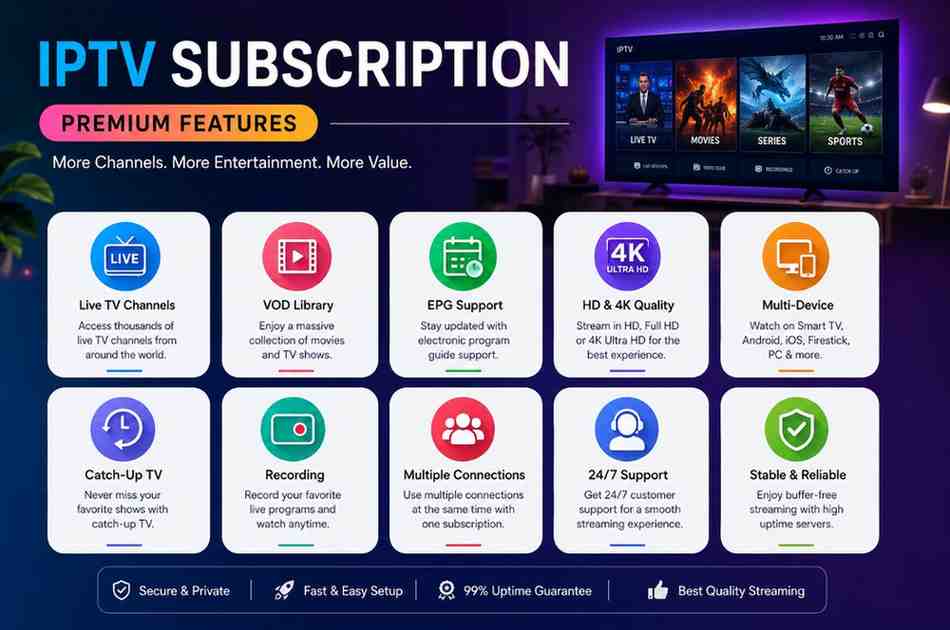
What distinguishes a genuinely premium IPTV service from a reseller or an unstable operation:
- Infrastructure investment: Premium providers operate multiple redundant servers across different regions. If one data center experiences issues, traffic is rerouted automatically without interrupting your stream.
- Anti-freeze technology: Advanced buffering algorithms pre-load several seconds of content, eliminating the "spinner" effect that plagues free IPTV services.
- High bitrate encoding: Channels are encoded at 4K (25 Mbps), Full HD (8–12 Mbps), or HD (4–6 Mbps), producing noticeably sharper images than compressed free streams.
- Professional EPG: A complete 7-day electronic program guide with accurate scheduling, cover art, genre filters, and search functionality.
- Multi-device support: Native apps for Android TV, Firestick, iOS, Smart TV, MAG boxes, and Windows — all synchronized under a single subscription.
- Responsive support: Live chat and ticket systems staffed 24/7, not a Telegram group where questions go unanswered for days.
The result is a viewing experience that rivals or exceeds cable television, at roughly 15% of the cost. For households that watch more than a few hours of TV per week, the upgrade from free IPTV or cable to a premium service is immediately noticeable in both picture quality and reliability.
Pros and Cons: What to Expect
No service is perfect, and a premium IPTV subscription comes with trade-offs that every buyer should weigh before committing. Here's an honest breakdown based on months of testing and user feedback across IPTV communities.
✓ Pros
|
✗ Cons
|
Premium IPTV vs Free IPTV vs Traditional Cable: Comparison Table
To make an informed decision, it helps to see the three primary viewing options side by side. The table below compares the metrics that matter most to the average household.
| Feature / Metric | Premium IPTV | Free IPTV | Traditional Cable |
|---|---|---|---|
| Monthly Cost | $10–$20 | $0 (but unstable) | $60–$120 |
| Channel Count | 20,000+ | 1,000–5,000 | 100–300 |
| Stream Stability | 99.9% uptime | Frequent buffering | 100% dedicated |
| Video Quality | 4K / FHD / HD | SD / HD | Up to 4K |
| Device Support | All platforms | Limited | Set-top box only |
| Customer Support | 24/7 live chat | None | Phone / on-site |
| VOD Library | 40,000+ titles | Limited | Limited |
| Legal Risk | Low–Medium | High | None |
| Contract Required | No | No | Yes, often 12–24 months |
The data makes one thing clear: a premium IPTV service delivers cable-level stability and a dramatically larger channel library at roughly 15% of the cost. Free IPTV is not a real alternative for anyone who values consistent quality.
Cost-Benefit Analysis: Is It Worth It?
The math is straightforward. A typical premium IPTV subscription costs between $10 and $20 per month, depending on the package length. Annual plans often bring the effective cost down to $8–$12 per month. Compare that to the average cable bill of $89 per month in the United States, and the savings exceed 80% annually — over $900 per year.
What you sacrifice with IPTV: no physical set-top box, no local franchise customer service, and the need to manage your own hardware. What you gain: a channel lineup 100 times larger, 4K quality, VOD access, and the freedom to watch on any device, anywhere in the world.
Who Should Buy a Premium IPTV Service?
Ideal candidates:
- Cord-cutters who want cable channels without the cable bill
- Sports fans who need international leagues (Premier League, NBA, UFC, cricket, F1)
- Expats seeking home-country news, sports, and entertainment channels
- Families who want live TV plus a VOD library in one unified app
- Tech enthusiasts who prefer a single subscription across all their devices
Who should NOT buy:
- Users with internet speeds below 15 Mbps
- Those uncomfortable installing third-party apps on their devices
- Viewers in jurisdictions with strict IPTV enforcement (check local laws first)
Buyer Considerations: What to Verify Before Subscribing
- Trial period: A reputable premium IPTV service offers a 24–48 hour trial for a nominal fee. Never commit to an annual plan without testing the service first.
- Device compatibility: Confirm the service has a native app for your specific device (Firestick, Android TV, iOS, Smart TV, MAG).
- Payment security: Look for providers using encrypted payment gateways such as Stripe, PayPal, or verified card processing. Avoid services that only accept cryptocurrency or bank transfers.
- Real reviews: Search for independent reviews on Reddit, Trustpilot, and IPTV forums. Beware of providers with reviews only on their own website.
- Simultaneous connections: Check how many devices can stream at once. Most premium services allow 2–4 connections per subscription.
- Refund policy: The best providers offer a money-back guarantee within 24–48 hours of activation. If a provider refuses refunds entirely, walk away.
- Server transparency: Legitimate operators publish uptime statistics or maintain a public status page. Opaque providers are a red flag.
The Bottom Line on Premium IPTV Service
Proceed with confidence if you want a buffer-free, multi-device IPTV experience at a fraction of cable pricing. The verified provider below offers the best combination of channel depth, stream stability, and buyer protection currently available.
Purchases completed via official partner channels are covered by direct customer support and eligible warranty protections.
Frequently Asked Questions
Is a premium IPTV service legal?
The legality depends on your country and the content licensing agreements the provider holds. In many jurisdictions, streaming copyrighted content without proper licensing is a legal gray area, though enforcement is typically directed at providers and resellers rather than end users. For personal use, most subscribers face minimal risk, but you should research your local regulations before subscribing. Reputable premium services operate transparently and clearly state their licensing status.
What internet speed do I need for premium IPTV?
For a smooth experience, you need at least 10 Mbps for HD streams and 25 Mbps for 4K content. A wired Ethernet connection is recommended over Wi-Fi for consistent performance. If you plan to stream on multiple devices simultaneously, add 10–15 Mbps per additional screen. Lower speeds will still work, but you may experience occasional quality drops as the adaptive bitrate adjusts.
Can I use a premium IPTV subscription on multiple devices?
Yes. Most premium IPTV providers allow 2–4 simultaneous connections per subscription. This means different household members can watch different channels on different devices at the same time. Some providers also offer account-level device management, letting you remove old or unused devices from your account remotely. Always confirm the exact connection limit before purchasing.
What is the difference between premium IPTV and free IPTV?
Premium IPTV services operate dedicated servers, use CDNs, offer 24/7 customer support, and provide stable 4K/FHD streams with anti-freeze technology. Free IPTV services are typically unmaintained playlists hosted on public servers, with frequent buffering, low resolution, broken channels, and no support. Free services also carry higher legal risk because they rarely have content licensing. The paid service is essentially the difference between a professional product and a hobby project.
Do I need a VPN for premium IPTV?
A VPN is recommended but not strictly required. Some ISPs throttle IPTV traffic, which can cause buffering. A VPN encrypts your traffic and prevents throttling, and it also adds a layer of privacy. Choose a VPN with fast servers and support for your streaming device. Note that using a VPN may slightly increase latency, so select a server close to your physical location for the best performance.
What happens if the premium IPTV service experiences downtime?
Reputable premium providers operate redundant servers across multiple data centers, so downtime is rare. If an outage does occur, the provider's status page will show the issue, and their support team will typically post updates. Most providers compensate affected users by extending their subscription for the downtime period. This level of accountability is another reason to choose a verified premium service over a free playlist.
How do I set up a premium IPTV service?
Setup takes about five minutes. After subscribing, you receive credentials via email. Then you install the provider's app on your device (Firestick, Android TV, iOS, Smart TV, MAG, or PC), enter your username and password, and the channel list and EPG load automatically. Most providers also offer a setup tutorial video and live chat assistance for first-time users. No technical knowledge is required.
What refund policy should I expect from a premium IPTV provider?
A trustworthy premium IPTV provider offers a money-back guarantee, typically 24–72 hours from activation. This gives you time to test stream quality, channel coverage, and device compatibility without financial risk. If a provider refuses to offer any refund window, that is a significant red flag. Read the refund terms carefully before purchasing, and use a payment method that provides additional buyer protection.
Transparency & Disclosure: We independently evaluate products. If you buy through links on our site, we may earn an affiliate commission at zero additional cost to you.