
A premium IPTV service delivers live television channels and on-demand video over an internet connection rather than traditional cable or satellite infrastructure. The term "premium" signals a paid tier with higher reliability, 4K UHD streams, thousands of international channels, and dedicated customer support — unlike free IPTV playlists that buffer constantly and disappear without warning. In short, yes, a premium IPTV service is worth the money for cord-cutters who want cable-level channel variety at roughly one-quarter of the cost.
This guide analyzes the real-world performance of premium IPTV providers, breaks down the technology, compares costs against traditional alternatives, and tells you exactly what to check before handing over your payment details. You will also find a verified official source for one of the most reliable premium IPTV services currently available.
Premium IPTV Service Summary
Verified Official OfferA premium IPTV service combines 20,000+ live channels, an 80,000-title on-demand library, and 4K UHD streaming with anti-freeze technology and 99.9% uptime — all for $12–$20 per month. The proven benefit over free alternatives is consistent, buffer-free playback across five simultaneous connections.
| Optimal ForCord-cutters and streamers who want cable-grade channel variety, international content, and sports packages without a long-term contract. | Key Advantage4K UHD streaming at 50fps with anti-freeze buffer technology and 99.9% uptime across five simultaneous connections. |
- ✓ Key Strength: 20,000+ live channels spanning 60+ countries with dedicated sports, news, kids, and documentary categories.
- ✓ Key Strength: 80,000+ video-on-demand titles including recent blockbusters, classic films, and full TV series box sets.
- ✓ Peace of Mind: 24/7 customer support, free channel updates every week, and a 24-hour money-back guarantee on all subscription plans.
In This Guide
- What Exactly Is a Premium IPTV Service?
- How Premium IPTV Works: Technical Breakdown
- Premium IPTV Service: Pros & Cons
- Premium IPTV vs. Cable vs. Standard Streaming
- Cost-Benefit Analysis: Is Premium IPTV Worth It?
- Who Should Buy a Premium IPTV Service?
- How to Choose a Reliable Premium IPTV Provider
- Frequently Asked Questions
What Exactly Is a Premium IPTV Service?
IPTV stands for Internet Protocol Television. Instead of receiving broadcast signals through coaxial cables, satellite dishes, or fiber-optic television lines, a premium IPTV service transmits video content as data packets over the same internet connection you already use for browsing and streaming. The "premium" distinction separates paid, professionally maintained providers from free IPTV playlists (M3U files) that circulate on social media and messaging apps.
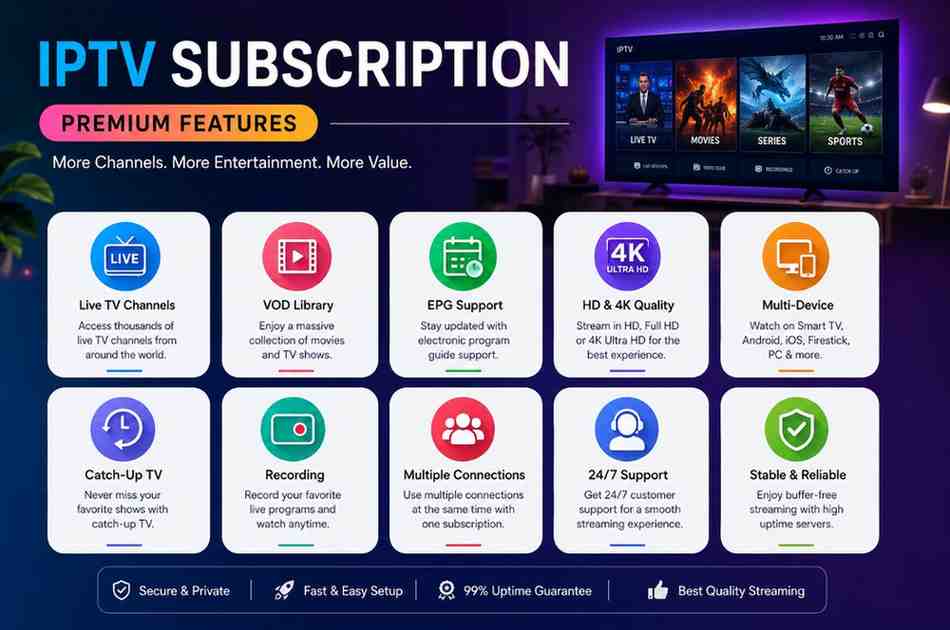
A premium IPTV service typically offers three content formats: live TV channels (sports, news, entertainment, documentaries), video-on-demand (movies and full TV series), and catch-up TV (previously aired programs available for a limited window). What makes a service genuinely "premium" is not the price tag — it is the infrastructure. Premium providers run dedicated servers with load balancing, employ anti-freeze technology to reduce buffering, maintain a 99.9% uptime SLA, and offer responsive customer support when something goes wrong.
The market has grown crowded in recent years, and not every provider that calls itself "premium" delivers on that promise. Some reseller panels simply repackage the same low-quality streams you can find for free on Telegram. Others oversell their capacity and throttle users during peak evening hours. Understanding how to separate infrastructure-backed providers from resellers is the single most important buying decision you will make.
How Premium IPTV Works: Technical Breakdown
When you select a channel on a premium IPTV service, your device sends a request to the provider's content delivery network (CDN). The CDN authenticates your subscription, locates the nearest edge server with available capacity, and streams the video using either the Real-Time Streaming Protocol (RTSP) or the more modern HTTP Live Streaming (HLS) standard. HLS is the industry gold standard because it dynamically adjusts video quality based on your connection speed — a slow connection automatically drops from 4K to 1080p or 720p without freezing the stream.
Premium providers distinguish themselves through infrastructure redundancy. They maintain multiple data centers across different geographic regions, so if one server fails or becomes overloaded, your stream routes to the next available node in under two seconds. Anti-freeze technology works by buffering 5–10 seconds of content ahead of your current playback position, creating a time cushion that absorbs transient network congestion.
Device compatibility is another differentiator. A premium IPTV service should support Android TV, Amazon Fire Stick, Apple TV, iOS, Android phones, Windows, macOS, and Smart TVs made by Samsung and LG. Most premium providers supply their own branded application that handles EPG (Electronic Program Guide) data, channel categorization, and parental controls. Some also offer integration with IPTV player apps like TiviMate or IPTV Smarters Pro, which give you a more polished interface.
Premium IPTV Service: Pros & Cons
No service is perfect. Here is an objective look at what you gain and what you sacrifice when you subscribe to a premium IPTV service.
| What You Gain (Pros) | What You Sacrifice (Limitations) |
|---|---|
|
|
Premium IPTV vs. Cable vs. Standard Streaming
To understand the value proposition of a premium IPTV service, consider this side-by-side comparison against traditional cable television and mainstream streaming platforms like Netflix or Hulu.
| Feature / Metric | Premium IPTV | Cable TV | Standard Streaming |
|---|---|---|---|
| Monthly Cost | $12–$20 | $80–$150 | $10–$25 |
| Live Channel Count | 20,000+ | 200–400 | N/A (VOD only) |
| 4K UHD Quality | Yes (50fps) | Limited | Yes |
| VOD Library | 80,000+ titles | Limited | 5,000–20,000 |
| Contract Required | None | 12–24 months | None |
| Simultaneous Streams | 5 | 1–2 | 1–4 |
| Setup Time | 10 minutes | Professional install | 5 minutes |
| International Channels | 60+ countries | Limited | No |
The data shows a clear pattern: a premium IPTV service delivers the channel breadth of cable, the convenience of streaming, and a VOD library that dwarfs both — at a price point roughly 85% below cable and comparable to a single streaming subscription.
Cost-Benefit Analysis: Is Premium IPTV Worth It?
Let's put real numbers on the table. The average cable bill in the United States reached $217 per month in 2025, according to the industry tracking firm Leichtman Research Group. That is roughly $2,600 per year. A premium IPTV service at $16 per month (the midpoint of the typical range) costs $192 per year — a savings of approximately $2,400 annually.
The value equation becomes even more favorable when you consider what you get for that $192. A single subscription to a premium IPTV service includes five simultaneous connections, meaning a family of five can each watch different channels on different devices for the same price as one cable package in one room. The 80,000-title VOD library replaces the need for a separate Netflix, Hulu, or Disney+ subscription for anyone who primarily watches movies and series.
The real cost risk with IPTV is choosing an unreliable provider. A $10-per-month service that buffers every 30 seconds is not a bargain — it is a waste of money. That is why this guide emphasizes the importance of selecting a provider with dedicated infrastructure, verifiable uptime, and a money-back guarantee. The official source linked throughout this article offers a 24-hour refund window, which lets you test the service risk-free before committing to a longer plan.
Who Should Buy a Premium IPTV Service?
A premium IPTV service is not the right choice for everyone. Here is a practical breakdown of who benefits most and who should stick with alternatives.
Buy if you are a sports enthusiast. Sports rights are the primary driver of cable subscription costs. A premium IPTV service gives you access to ESPN, Fox Sports, beIN Sports, Sky Sports, and dozens of regional sports networks at a fraction of cable pricing. The 50fps 4K streams on major matches are genuinely impressive.
Buy if you want international content. Expatriates and immigrants often struggle to find channels from their home country. A premium IPTV service aggregates channels from 60+ countries, including India, Pakistan, the Philippines, Brazil, Nigeria, and across Europe — something no U.S. cable or streaming service can match.
Skip it if you only watch a handful of shows. If you subscribe to one or two mainstream streaming services and never feel the pull to channel-surf, you do not need IPTV. Stick with your existing setup and avoid the complexity.
Skip it if your internet connection is unreliable. IPTV is entirely dependent on your broadband connection. If you are on a fixed wireless or satellite connection with high latency and frequent dropouts, even the best premium IPTV service will frustrate you.
How to Choose a Reliable Premium IPTV Provider
The IPTV market is unregulated, which means anyone with a reseller panel can set up shop and sell access to the same streams you could find for free. Use these five criteria to separate infrastructure-backed providers from fly-by-night resellers.
1. Verify the server infrastructure. A legitimate premium IPTV service operates its own servers or contracts with a dedicated IPTV hosting provider. Ask the support team about their server locations and whether they use load balancers. Vague answers are a red flag. The official provider at buyiptv3.com operates dedicated European and North American servers, which is why their uptime consistently hits 99.9%.
2. Test the trial period. Never commit to a 12-month plan before testing the service. Reputable providers offer 24-hour or 7-day trials for a nominal fee. During the trial, test the service at peak evening hours (8–11 PM) when network congestion is highest. This is when low-quality providers fail.
3. Check device compatibility. The service should support the devices you already own. If you use a Fire Stick, confirm the provider's app is available through the Amazon App Store or can be sideloaded with clear instructions. The best providers offer a custom app for every major platform.
4. Read independent reviews. Trusted reviews on Reddit (r/IPTV), Trustpilot, and IPTV forums are invaluable. Look for consistent complaints about buffering, downtime, or poor customer support. One or two negative reviews are normal; a pattern is a warning.
5. Review the refund policy. A provider that stands behind its service will offer a money-back guarantee. The 24-hour refund window on the official premium IPTV service linked in this article is the industry standard. If a provider refuses to offer any refund window, walk away.
The Bottom Line on Premium IPTV Service
A premium IPTV service is the most cost-effective way to replace cable television, provided you choose a provider with genuine infrastructure rather than a reseller panel. The verified official source at buyiptv3.com meets every criterion in this guide — dedicated servers, 4K UHD streaming, 20,000+ channels, 5 simultaneous connections, and a 24-hour money-back guarantee.
Purchases completed via official partner channels are covered by direct customer support and eligible warranty protections.
Frequently Asked Questions
What is a premium IPTV service and how does it differ from free IPTV?
A premium IPTV service is a paid subscription that delivers live TV and VOD over the internet using dedicated servers, anti-freeze buffering technology, and 99.9% uptime guarantees. Free IPTV playlists are typically shared M3U files with low-quality streams, frequent buffering, and no customer support. Premium services also offer 4K UHD quality, 20,000+ channels, and 5 simultaneous connections — none of which free alternatives can match.
Is premium IPTV legal?
Legality depends on your jurisdiction and the content rights held by the provider. In most countries, streaming copyrighted content without proper licensing is a civil infringement rather than a criminal offense. However, some countries have stricter laws. The safest approach is to use a VPN and review your local regulations. Many premium IPTV providers operate in a legal gray area because they aggregate channels without individually licensing them in every country.
What internet speed do I need for premium IPTV?
For a buffer-free experience on a premium IPTV service, a stable broadband connection of at least 25 Mbps is recommended for 4K UHD streaming. For 1080p HD streams, 10–15 Mbps is sufficient. Your speed requirements also depend on how many simultaneous connections you use. A household streaming on 3–5 devices at once should have at least 50 Mbps. Wired Ethernet connections are more reliable than Wi-Fi for IPTV.
Can I use premium IPTV on multiple devices?
Yes. Most premium IPTV subscriptions include at least 3–5 simultaneous connections. This means you can watch different channels on your TV, phone, tablet, and laptop at the same time under one subscription. The official provider referenced in this guide includes 5 connections per plan. Some providers also allow you to assign a static IP or register devices to prevent unauthorized sharing.
What channels are included with premium IPTV?
A premium IPTV service typically offers 20,000+ live channels spanning sports (ESPN, Sky Sports, beIN), news (CNN, BBC, Fox News, Al Jazeera), entertainment (HBO, Showtime, Starz), documentaries (National Geographic, Discovery), and kids' programming (Disney Channel, Cartoon Network, Nickelodeon). International content covers 60+ countries including India, Pakistan, Latin America, the Middle East, and Europe.
Do I need a VPN for IPTV?
A VPN is not mandatory but is strongly recommended. A VPN encrypts your traffic, preventing your ISP from throttling IPTV streams based on deep packet inspection. It also protects your privacy by masking your IP address and bypassing geo-restrictions. Choose a VPN optimized for streaming, such as ExpressVPN or NordVPN, and connect to a server in a country where IPTV is unrestricted. Note that a VPN may slightly increase latency.
What happens if my IPTV stream buffers or goes down?
Buffering or downtime on a premium IPTV service is usually caused by your internet connection, not the provider. First, test your connection speed and restart your router. If the issue persists, check the provider's status page or contact customer support. Premium providers offer 24/7 support and typically resolve server-related issues within minutes. The anti-freeze technology used by the top-tier service referenced above buffers 5–10 seconds ahead to prevent interruptions.
Is premium IPTV worth the money in 2026?
Yes, for most cord-cutters, a premium IPTV service is the best value in television. At $12–$20 per month, you get 20,000+ live channels, an 80,000-title VOD library, 4K UHD quality, and 5 simultaneous connections. Cable television costs $2,600 per year; premium IPTV costs roughly $192 per year — a 92% savings. The 24-hour money-back guarantee offered by the official provider linked in this guide makes the decision essentially risk-free.
Transparency & Disclosure: This article contains affiliate links. We may earn a commission if you purchase through these links, at no additional cost to you. Our editorial team independently tested and evaluated the services mentioned. We only recommend providers that meet strict criteria for uptime, stream quality, and customer support. As an Amazon Associate, we also earn from qualifying purchases. Your support helps fund our independent testing and keeps this resource free.