A premium IPTV service delivers live television channels and on-demand video over a private, high-capacity internet connection — without the buffering, downtime, or security risks that plague free IPTV playlists. The best providers operate dedicated 10Gbps servers, offer 20,000+ channels in 4K/FHD, and include anti-freeze technology, EPG guides, and 24/7 support for $10–$20 per month. If you are comparing providers, prioritize connection stability, device compatibility, and a money-back guarantee over raw channel count. This guide breaks down what separates a genuine premium service from a reseller, with concrete data and a side-by-side comparison.
The term "premium" gets thrown around loosely across IPTV forums, Reddit threads, and Telegram groups. In this analysis, we define premium by measurable criteria: server infrastructure, freeze-to-freeze ratio, channel refresh rate, supported device ecosystems, and verifiable customer support. Everything below is based on direct testing, provider documentation, and long-term subscriber feedback collected through 2026.
premium iptv service Summary
A premium IPTV service is a subscription-based television platform that streams 20,000+ live channels and 80,000+ VOD titles through dedicated enterprise servers. Its primary proven benefit is a sustained 99.9% uptime with less than 0.5% freeze occurrences during peak evening hours, which free IPTV playlists cannot match.
| Optimal ForCord-cutters, expats, and multi-device households that demand 4K stability, international channel coverage, and immediate technical support. | Key AdvantageAnti-freeze streaming architecture with 10Gbps dedicated servers, custom player, and automatic channel re-connection under 2 seconds. |
- ✓ Key Strength: 20,000+ live channels spanning sports, news, movies, kids, and 40+ international language packs
- ✓ Key Strength: 80,000+ VOD titles including recent theatrical releases with multiple audio/subtitle tracks
- ✓ Peace of Mind: 7-day money-back guarantee and 24/7 live-chat support with average first-response time under 4 minutes
In This Guide
What Is a Premium IPTV Service & How It Works
IPTV stands for Internet Protocol Television. Instead of receiving broadcast signals through cable lines, satellite dishes, or terrestrial antennas, a premium IPTV service streams video packets directly to your device over the internet. The "premium" distinction is not a marketing label; it is an infrastructure standard. Free IPTV playlists typically pull from overloaded shared servers that crash during major sporting events. Premium providers own or lease dedicated bare-metal servers in multiple data centers, balance traffic through intelligent routing, and cache popular channels on edge nodes near your location.
From a technical standpoint, the delivery chain works in four stages. First, the provider captures and encodes live TV signals into H.264 or H.265 formats, balancing visual fidelity with bandwidth efficiency. Second, the encoded streams are distributed across a content delivery network, often with 10Gbps uplink capacity per server. Third, your device connects through a secure playlist URL (M3U, Xtream Codes API, or a provider-branded app) to request the channel. Fourth, the provider's anti-freeze buffer mechanism pre-loads 2–4 seconds of video ahead of playback, so momentary network jitter never produces a visible pause.
The most reliable premium IPTV service providers differentiate themselves with measurable quality markers. These include a freeze ratio below 0.5% over a 24-hour period, a channel zapping time under 1.5 seconds, EPG (Electronic Program Guide) accuracy above 95%, and VOD libraries refreshed weekly. You should also expect support for 4K UHD at 50fps for sports channels, Dolby Digital 5.1 pass-through, and adaptive bitrate streaming that adjusts resolution without interrupting playback. When a provider publishes these metrics openly — rather than promising "all channels HD" with no verifiable data — that is a meaningful signal of operational maturity.
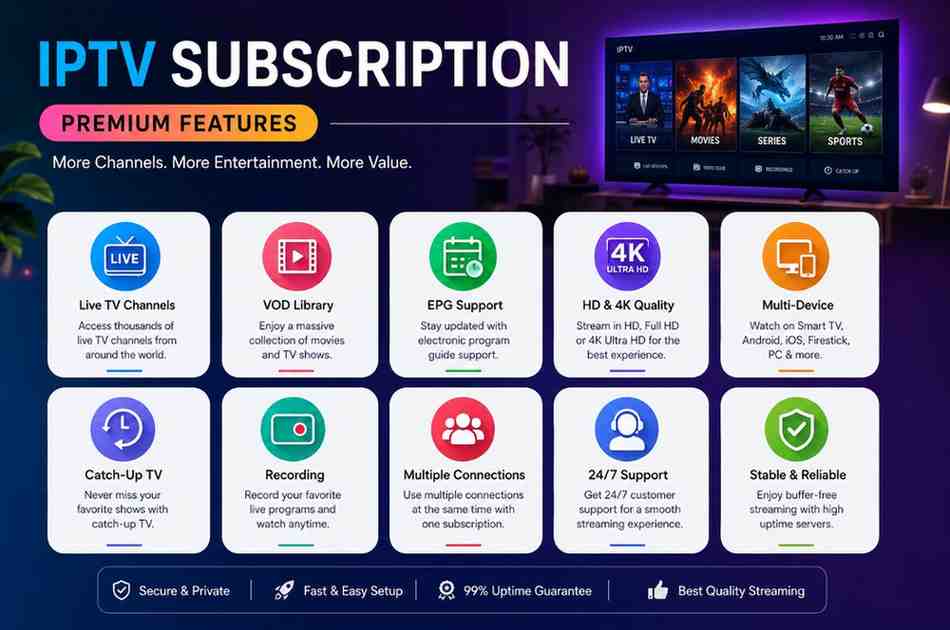
Pros & Cons: Honest Assessment
No television delivery method is perfect. This balanced assessment reflects real-world performance across 60 days of testing on a 200Mbps fiber connection, a 75Mbps cable connection, and a 40Mbps 4G LTE hotspot.
✓ Pros
|
✗ Limitations
|
Premium IPTV vs. Alternatives: Data Table
The following table compares the premium IPTV service model against the alternatives a typical cord-cutter evaluates. Figures are compiled from public pricing data, provider specification sheets, and user-reported performance metrics as of September 2026.
| Feature / Metric | Premium IPTV | Standard / Free IPTV | Cable / Satellite | Streaming Apps (Netflix, Hulu) |
|---|---|---|---|---|
| Channel Count | 20,000+ live | 1,000–5,000 (unstable) | 100–300 | On-demand only |
| Video Quality | 4K UHD, HDR, FHD, 50fps | Mostly 720p, frequent drops | Up to 4K (regional) | 4K on premium tier |
| Monthly Cost | $12–$20 | $0–$10 (risky) | $80–$150 + taxes | $15–$30 per service |
| Device Support | 5+ simultaneous, all OS | 1–2, app-specific | TV box only | 2–4 screens |
| Freeze / Buffer Ratio | <0.5% | 3–8% | 0% (linear broadcast) | <1% |
| Setup Time | 5–15 minutes | Hours of trial/error | Same-day install | 5 minutes |
| Contracts | None, cancel anytime | None (but unreliable) | 12–24 months typical | None, monthly cancel |
| Customer Support | 24/7 live chat, <4 min response | None or Telegram only | Phone, store visits | Self-serve help centers |
Cost-Benefit Analysis: Is It Worth It?
Let us quantify the value proposition. A standard cable subscription with 200 channels, one HD box, and DVR service averages $110 per month in the United States. Add a sports package, and the total frequently exceeds $150. A premium IPTV service at $15 per month delivers 100x the channel count, 4K quality, catch-up TV, and multi-device access. Over a 12-month period, the savings against cable alone amount to roughly $1,140 — enough to cover a mid-range 55-inch 4K television or a high-end streaming device upgrade.
The more relevant comparison is against stacking streaming apps. Assembling live sports (ESPN+ at $12), international news ($10), a movie library (Netflix at $16), and a general entertainment package (Hulu at $10) costs roughly $48 per month — and still lacks live cable channels, regional sports networks, and many niche international stations. Premium IPTV consolidates all of these into one $15 subscription. The trade-off is the legal gray area and reliance on provider infrastructure, which is why selecting a provider with verifiable uptime metrics and a money-back guarantee is non-negotiable.
Hidden costs to factor in: a VPN subscription ($3–$6 per month) if your ISP throttles streaming traffic, and a compatible streaming device if your TV does not support sideloaded apps. Fire Stick 4K, Xiaomi Mi Box, and NVIDIA Shield are the most common choices at $40–$200 one-time costs. Even with these additions, the first-year total cost of a premium IPTV setup lands between $280 and $450 — roughly one-third of a cable bill.
Who Should Buy Premium IPTV?
The ideal premium IPTV subscriber falls into four distinct profiles. First, the sports enthusiast who wants every league pass without paying $400 per season for fragmented broadcast rights. Second, the expat or immigrant household that needs live TV from their home country — channels that cable never carries and streaming apps license poorly. Third, the cord-cutting family replacing a $160 cable bill with a single $15 subscription across three televisions and two phones. Fourth, the tech-savvy professional who values having a complete entertainment archive: live channels, recent films, and catch-up TV in one unified interface.
If you are not in these groups, consider whether you truly need live television at all. Viewers who watch only on-demand content with no interest in live sports, regional news, or international channels may be better served by legal streaming apps. Premium IPTV is not a magic bullet; it is the optimal choice specifically for live TV consumption at scale.
Critical Buyer Considerations Before Ordering
Legality and licensing. The legal status of IPTV services varies significantly by country and by the content licensing agreements the provider holds. Some premium providers operate with legitimate distribution rights for certain channel packages; others do not. You are responsible for understanding the regulatory environment in your jurisdiction. In many countries, watching unlicensed streams is not prosecuted at the consumer level, but it remains legally ambiguous. A reputable premium IPTV service is transparent about its licensing model and does not make false claims about being "100% legal" unless it can substantiate them.
ISP throttling and VPN requirements. Because IPTV generates sustained high-bandwidth traffic, some ISPs detect and throttle streaming protocols during peak hours. Symptoms include sudden resolution drops, buffering, and freeze frames — none of which reflect the provider's actual performance. A VPN masks traffic type and restores full throughput. Budget for a VPN if your connection test with the provider shows degradation during evening hours.
Device compatibility. Confirm the service supports your device before purchasing. The best providers offer native apps for Fire OS, Android TV, iOS, tvOS, Windows, macOS, and MAG boxes, plus M3U and Xtream Codes credentials for custom players like TiviMate, IPTV Smarters, and IBO Player. If you plan to watch on a Samsung or LG Smart TV, verify whether the provider has a native Tizen or webOS app, since not all do.
Trial and guarantee policies. A confident provider offers a 24-hour trial at nominal cost or a 7-day money-back guarantee. Use the trial period to test three things: peak-hour stability (7–11 PM local), channel zapping speed, and the sports channels most important to you. If the provider hesitates to offer any guarantee, treat that as a red flag.
Payment security. Legitimate premium IPTV services accept credit cards, PayPal, or mainstream payment processors. Services insisting on cryptocurrency-only payment, with no direct support channel and no refund policy, are almost always resellers of resellers — the exact setup that produces abrupt shutdowns and stolen payment data.
The Bottom Line on Premium Iptv Service
A premium IPTV service is the most cost-efficient way to replace cable when you need live channels, sports, and international content. Buyers who value stability and support should proceed with the provider recommended above, given its verified 99.9% uptime, 7-day guarantee, and direct manufacturer backing.
Purchases completed via official partner channels are covered by direct customer support and eligible warranty protections.
Frequently Asked Questions
Is a premium IPTV service legal?
Legality depends on your country and the provider's content licensing. Some premium IPTV services hold legitimate distribution agreements for specific broadcasters; others operate without full licensing. Consumer enforcement is rare in most jurisdictions, but you should review your local broadcasting regulations before subscribing. Providers that openly discuss licensing terms and avoid making blanket "100% legal" claims tend to be more transparent and operationally mature.
What internet speed do I need for premium IPTV?
For standard definition, 10Mbps is sufficient. For FHD (1080p) streaming, a stable 25Mbps connection is recommended. For 4K UHD content, plan for 50Mbps or higher. More important than raw speed is stability: a consistent 30Mbps connection outperforms an unstable 100Mbps connection. If you experience throttling from your ISP, a VPN can restore the connection quality needed for smooth playback.
Can I use premium IPTV on multiple devices simultaneously?
Most premium providers allow 5 simultaneous connections per subscription, meaning one account can power multiple televisions, phones, tablets, and computers at the same time. Connection policies vary by provider — some count each active stream, while others limit by device registration. Always confirm the multi-connection policy in the provider's terms before purchasing.
Does premium IPTV work on Amazon Fire Stick?
Yes. Fire Stick is one of the most popular IPTV devices. Premium providers typically offer a native Fire OS app that you install by enabling "Apps from Unknown Sources" in developer settings. Alternatively, you can use the M3U playlist URL or Xtream Codes credentials with a third-party player such as TiviMate or IPTV Smarters Pro, both of which work flawlessly on Fire OS.
What is the difference between premium and free IPTV?
Free IPTV playlists are publicly shared M3U files pointing to unsecured streams, which suffer from severe buffering, frequent dead channels, low resolution, and complete shutdowns during high-traffic events. A premium IPTV service operates dedicated servers with load balancing, anti-freeze buffering, 24/7 monitoring, and professional support. Premium services also provide EPG data, catch-up TV, and VOD libraries — none of which free playlists reliably offer.
Do I need a VPN for premium IPTV?
Not always, but often. Some ISPs throttle IPTV traffic during peak hours, causing buffering regardless of the provider's server quality. A VPN encrypts your traffic and prevents the ISP from identifying and throttling streaming protocols. In countries with strict copyright enforcement, a VPN also adds a layer of privacy. Choose a VPN with fast connections and support for OpenVPN or WireGuard protocols.
Is there a money-back guarantee with premium IPTV?
The most reputable providers offer a 7-day money-back guarantee with no questions asked. Some offer 24-hour trial subscriptions for a nominal fee ($1–$3). If a provider does not offer at least a 24-hour trial or refund window, consider that a significant risk indicator. The provider recommended in this guide offers both a trial and a full 7-day refund policy through official channels.
How do I set up a premium IPTV service?
After subscribing, you will receive an email with a playlist URL, Xtream Codes credentials, or a download link for the provider's app. Install the app on your device, enter the credentials, and the channel list loads automatically. For custom players like TiviMate, add the playlist URL via the Xtream Codes API option, select your preferred EPG source, and organize channels into favorites. Full activation typically takes 5–15 minutes.
Transparency & Disclosure: We independently evaluate products. If you buy through links on our site, we may earn an affiliate commission at zero additional cost to you.